

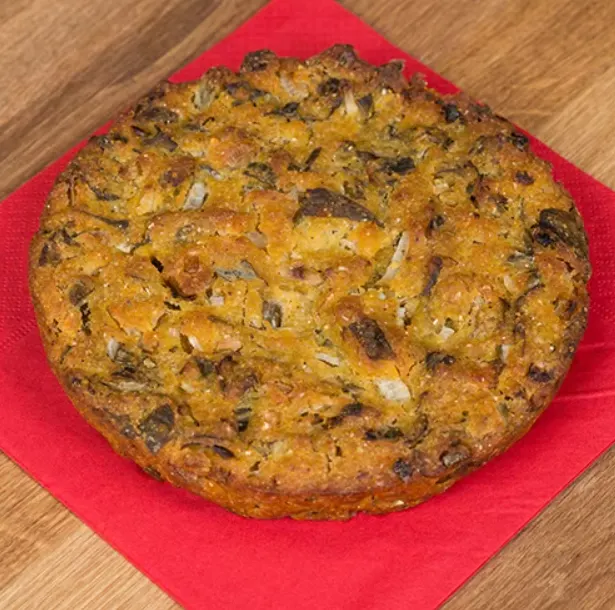
Most bread in Turkey is wheat. Along the Black Sea coast, though, many home cooks bake something denser: a cornmeal loaf studded with chopped fresh anchovies, greens, and onion. It is called hamsili ekmek, and it is one of the region’s most distinctive everyday foods.
Hamsili ekmek means “bread with anchovy.” It is a baked cornmeal loaf from northern Turkey, mixed with chopped anchovies, chard, parsley, and olive oil. A serving, one-ninth of the recipe below, gives roughly 15 grams of protein, just under a gram of omega-3 fat, and a useful amount of calcium, though the salt content depends on the cook.
Where hamsili ekmek comes from
The name is plain Turkish. Ekmek is bread, and hamsili means “with anchovies.” The dish belongs to the Black Sea coast, where cooking leans on corn and fish. One travel writer notes that only in this region does table bread mean dense, crumbly cornbread. Hamsili ekmek is mostly a home recipe, though some restaurants that serve regional food list it, according to Hispanatolia.
The fish is hamsi, the European anchovy (Engraulis encrasicolus), which a Hürriyet Daily News column calls the staple winter protein of the coast. Fresh hamsi season runs from November to February; outside it, the fish on sale is usually frozen.
How hamsili ekmek is made
The Hispanatolia recipe shows the basic method. For eight to ten servings, it calls for 500 g anchovies, 350 g corn flour, 300 g chopped chard, two chopped onions, six tablespoons of parsley, 50 ml olive oil, 50 ml water, and salt. Mix everything except the fish until even, then fold in the chopped anchovies. Press the mixture into a greased dish, cut it into squares, and bake at 180°C (350°F) for 40 to 50 minutes.
Tips for cooks outside Turkey
- Check the flour. Turkish recipes call for mısır unu, simply ground corn. In the US, “corn flour” is a finer product, and in Britain the term means cornstarch, which will not work here. Fine yellow cornmeal is the safest match.
- Find the fish. Fresh hamsi is rare outside Turkey. Frozen anchovies from a Turkish or Mediterranean grocer come closest, and fresh sardines or smelt are reasonable stand-ins with a different flavor. Most cooks remove the heads and guts first. The bones soften as the bread bakes.
- Watch the salt. Oil-packed canned anchovies carry about 3,668 mg of sodium per 100 g in USDA data, against roughly 104 mg for raw. If you use canned, use less and skip the added salt.
Nutrition facts and health benefits
No official nutrition label exists for this home recipe, so the figures below are an estimate for one-ninth of the Hispanatolia recipe, built from USDA-based anchovy data and standard values for the other ingredients, before any added salt.
| Per serving (1/9 of recipe) | Estimate |
|---|---|
| Calories | about 280 kcal |
| Protein | about 15 g |
| Fat | about 9–10 g |
| Carbohydrate | about 34 g |
| Fiber | about 4 g |
| Calcium | about 105 mg |
| Omega-3 | about 0.8 g |
| Sodium | about 130 mg, before added salt |
The anchovies do most of the work. Raw European anchovy has about 20 g of protein and 1.48 g of omega-3 fat per 100 g, plus 147 mg of calcium because the small bones are eaten, per USDA-based figures. The NIH Office of Dietary Supplements says the body gets EPA and DHA, the omega-3s in fish, mainly from food or supplements. Anchovies are also on the FDA’s “Best Choices” list for low mercury; its advice is two to three four-ounce servings of fish a week.
The rest of the loaf contributes too. Cornmeal supplies the carbohydrate and some fiber, and the recipe contains no wheat, so it can suit gluten-free diets if the cornmeal is certified gluten-free. Chard and parsley add more fiber, and olive oil accounts for about half the fat.
Limits worth knowing
Salt is the main variable. The Hispanatolia recipe lists salt without an amount. A teaspoon across the whole pan adds roughly 2,300 mg of sodium, or about 250 mg per serving, on top of what the anchovies and chard already contain. The bread is also not low in carbohydrate, since cornmeal makes up the bulk of it.
People with a fish allergy should skip it, and anyone with gout or a medical diet should check with a clinician first.
The short version
Hamsili ekmek shows how a coastline turns its two most available ingredients, corn and anchovies, into a filling loaf. Made at home, it offers solid protein, omega-3 fat, and calcium for roughly 280 calories a slice, as long as the salt stays in check.
8. FAQs
What does hamsili ekmek mean? Ekmek is Turkish for bread and hamsili means “with anchovies,” so the name translates as anchovy bread. It is a Black Sea cornmeal loaf made with chopped fresh anchovies.
Is hamsili ekmek healthy? It provides protein, omega-3 fats, and calcium, at an estimated 280 calories per serving. Salt is the main concern, because the recipe leaves the amount to the cook. Treat it as one part of a varied diet.
Can I use canned anchovies? Yes, but they are far saltier than fresh ones. USDA data lists about 3,668 mg of sodium per 100 g for oil-packed canned anchovies. Use less fish and leave out the added salt. The flavor and texture will also differ.
How long does it keep? The Hispanatolia recipe says it keeps for two days covered in the refrigerator.
Is hamsili ekmek gluten-free? The recipe contains no wheat, and cornmeal is naturally gluten-free. Check the cornmeal label for cross-contact if you avoid gluten for medical reasons.
Sourc: Engraulis encrasicolus, Hürriyet Daily News
Learn with us
Share the Taste with us: www.cookandshare.co
Cook Share Inspire
